Showing posts with label handwriting. Show all posts

Thursday, 11 February 2021

More Musings on snail mail, partial repost

Postage - do not cheat/defraud the postal authorities by using insufficient or invalid postage. A postage stamp can only be used once of sending an item of mail. If it has been postally used but remained unmarked, it is still not valid for postage. Also, many of the stamps offered for sale on ebay are NOT valid for postage, and some may even be forgeries (and could this even fund organised crime?). 

Royal Mail does have a reasonably accessible postage price finder on their website. I expect other postal authorities do too... Facebook groups have so much misinformation.

Seeing photos of snail mail on social media can be good for inspiration, discovering new ideas, and show that letter writing is not dead. Please, please do hide/obscure/blur the other person's address. UK postcodes are very specific and with the house number, it is just revealing as leaving the rest of the address. 10 / SW1A 2AA is the minimum needed for one iconic London address with a black front door.  Please do NOT share someone's address without their permission. I know I have on occasion, not realised an address was visible in a post.... and when I do realise, I remove the post. I feel utterly mortified I have not been diligent. Addresses can be out there in the public domain, but that doesn't give you good grounds to share them. 

As for sharing the contents of letters, the writer of the letter has more leeway. Incoming letters, the juicy contents shouldn't really be shared without permission, but the odd word or phrase... e.g. the date, greetings/salutations... maybe could be - you want to show off someone else's gorgeous (or not so neat) handwriting, or the ink they've used, ... It is a judgement call. A few years ago, I planned to do a blogpost on handwriting (not calligraphy), on the different styles of handwriting the letters arrived in. I did start preparations, so have photographed some common words (Dear, the date, Thank you for your letter, United Kingdom), but have yet to complete a post on it. 

Today's date is 11/02. What? 2nd of November? Much better to avoid confusion and write out the month. 

It does not matter if the letter cannot be finished in one sitting. I don't worry about pausing letterwriting, even after a short time. I do hope to have finished the sentence I am writing if I have to pause. I have started letters while writing for a friend on a night out (oh how I miss this). I am usually able to finish a sentence/paragraph when she turns up. 

It does not matter if you do not reply to letters in order of receipt. The content of some letters may demand a speedier reply than usual, or you need to delay a reply because someone is moving address and wants to get settled. People have their own rhythm. Mine tends to be a reply within a month of receipt. Occasional letters are fine too. Penfriendship doesn't have a set timetable.

The writing medium does not really matter. Paper meant to be written on, be it lined or blank or dotty or wavy, or with punched holes down the side and used by students to take lecture notes on (a school friend penpal wrote to me during her lessons), or reporter's notebook with pages on a spiral, or even actual letter writing paper. 

Embellishments, including stickers, washi tape and whatnot are not vital for a good penpal letter. I do use them myself though, because embellishing brings me joy. I cannot draw so some of the stickers can illustrate for me instead.

It doesn't matter if the letter is written with a fountain pen, dip pen, or ballpoint. I admit I find it easier to use a fountain pen as the ink makes the words flow across the page. 

The words matter! The content matters.

If you do not keep the letters/envelopes, consider saving the used stamps for charities (as they can raise money from sales to dealers/stamp collectors). There are plenty of charities in the UK raise some funds this way.

Letter travelling times may be slower than usual... One letter from France to the UK took 2 days in January, but a letter from the same person posted in June, only arrived this week! I'm not one for asking, "Did my letter arrive?" after only a few weeks/months. I know life/events happen making snail mail not a priority. However, sometimes a short missive, either postal or electronic, can make a big difference.

You can't be penfriends with everybody. Personalities can clash, beliefs can collide, or you just don't click. Penfriendship, like friendship, can wane... How many of you are in close contact with your best friends from primary or secondary school, or the neighbourhood you grew up in?

With the February letter writing projects, where you may receive letters from strangers, you might not feel able to reply to some of the letters. I know years ago before the Internet was more widely accessible, you could place an advert in a newspaper or magazine. One letter I received was from someone in prison (death row), and I didn't feel able to reply to it (I was a youngish adult), so did not reply. Other letters you might want to reply with a thanks (either via electronic message of some sort, or via the snail mail) even though you may not want the correspondence to continue, and that is fine too.  Though sometimes perhaps, you don't know if you want to continue or otherwise. Perhaps there's hope. Maybe something happens, a word is said or a place is mentioned, reminding you of a letter you received a few months ago and spurs you on to reply. Perhaps an occasional correspondence. There is hope. Life happens, stuff happens. Time. Patience. 

Friday, 15 January 2021

A to Z of Snail Mail - part 1

 I thought it would be fun to do an A to Z of Snail Mail. Easier said than done. Needed help & suggestions! 

A is for Address book, and also for Air Mail, Air Mail labels, aerogrammes, anticipation...

B is for Box of postcards, Best Wishes...

C is for Christmas cards sent by penpals, but also for cartridges fountain pens might use, calligraphy, and correspondence can contain caring and compassion.

D is for delivery, Diamine inks, and letters bring delight.

E is for envelope, and no matter how hard you push, it is stationery. Excitement & enlightenment.

F is for fountain pens. 

G is for General Post Office.

H is for Home (address), handwritten letters, and handwriting.

I is for ink, and also InCoWriMo, and international mail....

J is for Jolly letters written in J. Herbin ink (other inks are available). 

K is for the Kindness found in many letters, written perhaps with Krishna Ink.

L is for Letter, letter writing, letter writing paper, Lamy fountain pens & ink, letter openers, letterbox, and Love from..

M is for Mail, both incoming and outgoing missives mailed...


Part two later, but feel free to comment with your suggestions. Haven't gotten ideas yet for some of the other letters...

Thursday, 26 December 2019

December


It is that time of year where many of us reach out to old friends and family. Some would have sent just a Christmas card and perhaps with no other words other than the season's greetings, as other words may not be needed. Others would have enclosed a summary of the year with news of exam results, hobbies, and trips undertaken. Then, there are those who prefer the electronic means of communication (it doesn't cost a postage stamp or two). I am not a Luddite but I dislike email. The words might not even by your own as predictive text removes the need to think about what to write. Digital Christmas cards (not made out of paper) filled with emoji and/or animated gifs get easily forgotten. Handwriting shows thought and compassion, feeling and emotion. I know there are times the type-written/word-processed missives are the only way for some to correspond, whether due to writing-hand ill-health or a difficult bit of news to be repeated to many, so I do make exceptions.

Letters and cards are easier to treasure. Do you keep all those silly little email greetings, especially ones with URLs to the electronic greetings cards websites - would the message still be there on the website in 20 years time? Would your great great grandchildren be able to see the thoughtfulness of the message, or be able to open the attachment from the century-old email missive? Handwritten letters might not last forever (flood/fire) but wouldn't it be a shame that only scholars/well-educated people would be the only ones to be able to decipher the handwriting?

Sunday, 30 October 2016

To the Letter, and Remembrance

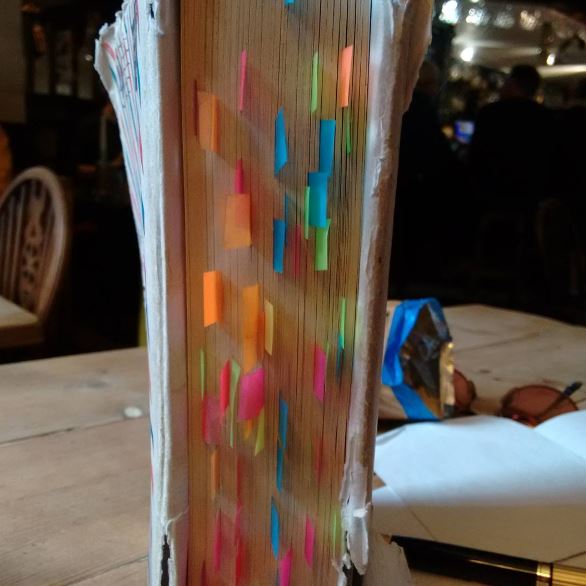
Now, almost 3 years later, I have finished To the Letter by Simon Garfield. I read the book slowly and marked many pages with highlighter tabs to note particularly interesting bits - some repeated below. 


I love the correspondence between Bessie Moore and Christopher Barker written while he was in the army during World War II. I will have to get Simon Garfield's book, My Dear Bessie which has more of the letters in than To the Letter. However, from To the Letter, I was able to garner wonder and emotion from these letters, for they contain humour, passion and concern:

"I am hanging on to the old old theory that no news is good news."

"Thanks for the letter, old-timer,I am sending this by Air Mail because it will have enough dull stuff in it to sink a Merchant ship." 

"How can I tell you I want to implant myself; how my lips need to meet your flesh everywhere, to kiss your hair, your ears, your lips......."

" 'How do I feel?' - such a large question sweetheart, oh such a large question! So difficult for me to tell you."

So, what do letters mean? More snippets from the book:

According to Emily Dickinson - "A letter always feels to me like immortality because it is the mind alone without corporeal friend." 

Katherine Mansfield wrote to a friend, "This is not a letter but my arms around you for a brief moment."

Ted Hughes describes letter-writing as "excellent training for conversation with the world."

"Without letters we risk losing sight of our history, or at least its nuance."

"Is a hand-held, ink-written letter more valuable to our sense of self and worth on the planet than something sent to a fortress of cables in the Midwest that likes to call itself a 'cloud'?"

A friend recommended The Why Factor, a radio programme broadcast on BBC World Service, and available online. One of the episodes was called Letters - broadcast a couple of years ago and had extracts of letters (including some between Bessie and Christopher). The programme spoke to John Steinbeck's son, Thomas about letters and letter-writing. From this episode, I do feel that letter-writing is a kind of armour against embarrassment for you can write words you may find difficulty in saying face-to-face. Also, I believe I am able to reveal myself more with ink on paper for I am a shy gal. 


We are coming up to 2 years shy for the centenary of the end of World War I. I have been to see the Weeping Window at Caernarfon Castle. 


One of the things I came across from doing citizen science was a project on the War Diaries of the British Army on the Western Front. The handwriting of the soldiers was neat although I was not used to all the handwriting styles used so took me a little while for me to decipher. The soldiers would have also sent many many letters home.


Their families grateful for every little bit of news from afar, even if it is about the weather. I wonder how many of these soldiers' families have kept these letters from World War I or even World War II (such as the family of Bessie and Christopher). Would the children of today be able to read them for many schools have discouraged or not taught joined up or cursive handwriting. Social and family history risk being lost. Will emails written today be treasured by generations to come?


Thursday, 19 May 2016

To The Letter.......

I am still plodding my way through Simon Garfield's wonderful book to The Letter I received for Christmas 2014. It is taking time to 'journey through a vanishing world' as I put clear sticky tabs/page markers at sections/sentences of particular note and interest. I don't always have these to hand and I dislike bent over corners. One of the points of interest I marked was Best Wishes, a sign off once used just for business letters and now, I almost always sign off my letters to penfriends with it. The book mentions correspondence of the Second Earl of Chesterfield and instructions to his daughter about putting the date at the bottom of the page because it is more respectful. When I write letters, I date it when I start. If I am unable to finish the letter in a day, I write the date when I recommence the missive. 

One thing I came across last night, was a description of a cat in a letter from a father to his daughter, as a mobile ginger flower - Ginger-dandelion. The letter writer was Ted Hughes. The chapter of the book was named The Modern Master. A collection of some of Ted Hughes' letters have been published. To The Letter also has a picture of Ernest Heminigway's cat walking across letters and correspondence on a bed. Some of my penpals have mentioned their cats getting in the way of snailmail by sitting on the letter, on the paper to be written on, on the table, or even the chair to be used at the letter writing desk.
Letter-writing - 'excellent training for conversation with the world.'
 I am over three quarters of the way through the book. I should finish it before Christmas 2016 and then, perhaps, I can follow up on selected bibliography and people mentioned, e.g. 
  • Abelard and Heloise
  • Second Earl of Chesterfield
  • Fourth Earl of Chesterfield
  • Letters of Ted Hughes
  • Letters Home (Sylvia Plath)
  • Madame de Sévigné
I wonder if there will be ebooks of the emails of some celebrity / author / entertainer / scientist / person of interest in years to come.

I wonder what people would make of letters answering Five Questions, part of the postal challenge on A World of SnailMail forum. Some of the questions asked can be a little silly. I recently answered a question unable to touch my nose with my tongue. Did you just try to do that yourself?

There is still time to ask Five Questions this month and answer others people's questions. Even some of my long time penpals incorporate answers (sometimes to other people's questions) in their letters to me.
'Maybe the crucial element in handwriting is that the hand is simultaneously drawing.'
Well, that is about all the drawing I can handle - letters!


So, why don't you surprise a family member or friend with a letter. One of the short stories broadcast on the radio last month mentioned a mother writing to her anorexic daughter in a bid to learn and help, and for this story, it worked. Taking time to write down thoughts and questions, without interruptions of, "You just don't understand..." or other speech-stoppers and the written dialogue continues in a calm manner. 

Letters connect people. Letters have brought more joy into my world. 


Saturday, 23 January 2016

February is nearly upon us!

Today I have been reminded from other blogs that it is National Handwriting Day. I have already done some handwriting as I composed a letter to a penpal. I should be writing more letters later including answering some 5Q5L some people have asked on my snailmail forum. There is still plenty of time to participate this month although I wonder if some members are saving up for the February letter writing frenzy of LetterMo and/or InCoWriMo

I have used up the last space in my address book for one of the letters. Do I start a new address book? I still have the Simon Drew address book my mother bought for my birthday a few years ago, as well as others I have bought along the way but haven't started. I suppose I could do with starting afresh as there are people who've moved or not continued with our correspondence. 

Tuesday, 19 January 2016

Snail Mail - the book

Venturing in to an independent bookshop opens eyes to a different range of books. On the top shelf, I saw the spine of a book in the colours of international correspondence and I reached up to grab it when I saw the title was, "Snail Mail." The secondary title, "Rediscovering the art and craft of handmade correspondence," had me hooked.
I bought the book and proceeded to devour it. In it, there is a section on various forms of communication. The one on e-mail suggests replying within 48 hours. I had a brief foray into email friendship but one e-pal was not happy if I did not reply to his daily emails. There seems to be a sense of urgency with emails requiring attention. Now, the only emails I want to receive are notifications. I rarely read them but their titles are comforting knowing that my Amazon order is on its way.
There are pages on types of mail - writing to congratulate/celebrate events, love letters (does anyone keep love e-mails not printed out?), condolence, fanmail (not a huge fan of this) and even letters to your future self.

There's a little bit on signing on and off. I hadn't thought starting a letter with your penpal's name (with no salutation greeting) as being stern. I do vary the initial greetings depending on mood and penpal. I use - Hi, Hello, Greetings, Dear, Annwyl... As for valedictions, I usually use Best Wishes but the book lists this as a business sign off (I knew that it was from Simon Garfield's book, To The Letter - I'm still plodding through this). I occasionally use Hugs but this is not mentioned.
There are ideas for decorating the snail mail, and there are stickers and labels in the back plus templates for making envelopes.
Another section covers handmade - making papers to write on. One had lines sewn in. Caution though is advised if sending to Australia as they have strict import regulations and post could get destroyed.

There are pages picturing used postage stamps, and some old letters - I can decipher the handwriting. There's a section on fonts, typefaces and handwriting styles. For handwriting, the book suggests trying out both cursive and block, but...
Overall, I am happy I bought this book but it is preaching to the converted. It is a nice book and would make the perfect gift for someone just starting out in the world of penpalling and snail mail. 

Tuesday, 24 February 2015

Post offices and prints


Last week, a new issue of stamps was released. I went to buy these from a little sub post office a few miles out of town. I spoke to the elderly gentleman behind the counter and was told he was retiring next month, but I will be able to buy the next issue of stamps from him. The post office is closing and moving across the road to a convenience store (Spar I think), but I doubt that they will be able to supply all my postal needs. Today, I came to another little post office where I bought the Paralympic stamps, thinking I could see if I will be able to get my postal needs in April from there, but no, that post office is also closing next month and will be relocated into Spar. The post office in the town I live in does not order enough stamps for my needs. So, where can I try next? Maybe the branch in a WHS in the nearby university town would be able to sell me the amount of stamps I need. If that fails, I guess I could resort to ringing up Royal Mail and placing my order direct (the postage would be cheaper than the bus fare to my lovely sub post office).
Today, I heard on the radio about an exhibition on at the Tate: Salt prints, photographs taken between 1840-1860. This has me thinking about another photographic format - digital images. Will our descendants be able to open and see all these images in full glory in 170 years time? Possibly the majority of salt prints created in the 19th century may well have been lost, but those remaining are "visible" but maybe the software and technology for today's digital photos, stored on hard drives or other media, may not be available for future generations.
Thinking then of correspondence, will our descendants be visiting a museum containing emails written by famous people? Many museums have letters in already, but there may be a generation now unable to read them because they are unfamiliar with cursive handwriting. I love the flow of "handwriting" as opposed to block letters written in ballpoint, in fact, usually I find the former easier to read (although it may take me a while to get used to a particular writing style). 

Tuesday, 10 December 2013

Season to be jolly

With Christmas nearly upon us, I notice a decrease in correspondence coming my way. I don't particularly mind as I will probably not reply this year to any letters arriving after the end of this week. I slow down, and do a few other things, spend time with the family and all that. It is not because I do not want to post letters at this time of year, it is just I do not want to rush letters out for them to sit in a mailbag for days when the postal service grinds almost to a halt over the festive period (especially if it is a White Christmas).I have a few more festive cards to send out internationally this week, but I also must not forget to send to my UK friends too. 

I don't send gifts to my penpals, except perhaps for a few simple flat things like stickers, interesting newspaper articles, postcards and photos. I wouldn't know what to gift, and with postage rates getting high plus there has been a change in regulations for what can be sent in the post. 

I was writing a reply to a beautifully handwritten (calligraphed) letter while sat in a cafe when I noticed I was being watched by a group of lads. One said that my handwriting was nice and I replied that it is if I use a fountain pen (I was using one), then went on to comment on a couple of schoolhood (is that actually a word?) events:
  • One history teacher marked me 1/10 for homework because he couldn't read my writing, however, I was unable to decipher his hand-scrawled comments
  • My biology teacher suggested I cease using a ballpoint pen  and use a fountain (cartridge) pen to improve my handwriting
I showed them the letter I was replying to and said that my handwriting wasn't as neat as my correspondent's. With fountain pens, you take more care with writing and this should make it more legible. I wonder if any of the lads will have a fountain pen in the near future!


 I haven't written any Postcrossing postcards for a while. Maybe I'll send some out this week, although for some destinations, it would probably by too late to arrive before Christmas. I haven't got any festive postcards - I haven't seen them in the shops here although a certain online shop does (but the only postcards I've ordered from them have been Pixar ones).


November stats:
Letters - out 13, in 8
Postcards - in 23
Other - in 6


Thursday, 11 October 2012

Handwriting

 As you can see, I do use fountain pens.... This one is a Parker Calligraphy pen (medium nib)
I write to my penfriends using fountain pens and last finished a letter today using one (it is now on route to France).
Yes, although it could be neater. If I use a Biro  it often isn't as neat. A fountain pen nib can seem rather delicate so I tend to write more carefully.
I look forward to receiving letters from penfriends and am able to recognise the sender, most of the time.

The reason for these questions is because of Philip Hensher. His book, The Missing Ink was published today and an extract appeared last weekend, in a newspaper and online by The Observer. Also, he appeared on Start of the Week with Andrew Marr on BBC Radio 4 earlier this week. The programme should be available to listen to online for at least a year at Start The Week, 8th October 2012.
The programme mentioned postcards.... They hadn't heard of Postcrossing!

The answer to last month's post about most important technology ever invented.... 25th was Writing, but... first was....
The Bra ??? Tools. Electricity. Wheel. Controlled Fire. Computer Games ??? AC Electricity...